Riverbend Solar: a 50 MW wheeled solar deal, modelled to financial close
A fictional 50 MW AC solar plant in the Northern Cape on a 20-year wheeled PPA, taken through the mechanics a lender tests, every figure from one model run.
- Equity IRR
- 21.6%
- vs 16.0% cost of equity
- Project IRR
- 14.6%
- vs 10.0% WACC
- Minimum DSCR
- 1.57x
- P50; 1.45x on one-year P90
- Senior debt
- R554.9m
- at 75% gearing
Read it your way
For engineers, plant and facility managers
A 62.5 MWp single-axis tracker plant with a P50 of 146,875 MWh a year, degrading 1% in year 1 and 0.4% a year after, and a year-12 inverter overhaul paid from a reserve. Wheeled to an industrial offtaker against an Eskom credit of R1.64/kWh.
Go to the technical lensFor CFOs, investors, developers and lenders
R554.9m of senior debt at 75% gearing, sized at the lowest of three lender tests. The gearing cap binds, leaving 1.57x minimum DSCR on P50 and 1.45x on one-year P90; equity IRR 21.6% against a 16.0% cost of equity.
Go to the financial lensThe brief
One ordinary solar deal, built properly
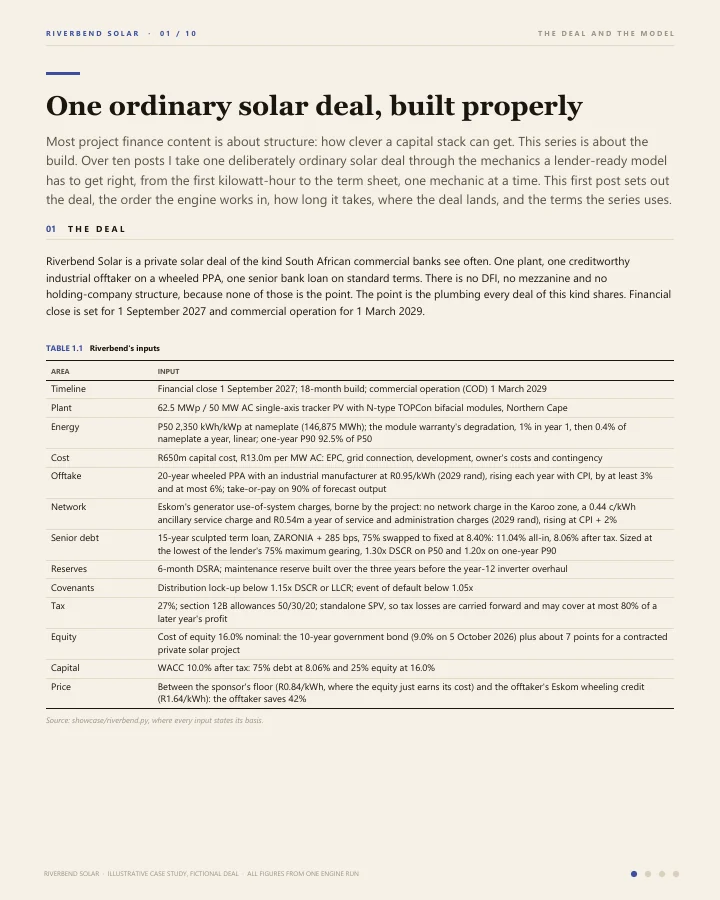
Riverbend Solar is a deliberately ordinary deal: a 50 MW AC / 62.5 MWp single-axis tracker plant in the Northern Cape, selling its output to an industrial manufacturer under a 20-year wheeled PPA at R0.95/kWh (2029 rand), rising with CPI.
Financial close is 1 September 2027 and commercial operation 1 March 2029, after an 18-month build. The R650m plant (R13.0m per MW AC) is funded by one senior bank loan and sponsor equity, with section 12B allowances inside a standalone SPV. No DFI, no mezzanine, no HoldCo.
Every number comes from a single run of one Python project-finance model. The ten-part series takes the deal through the mechanics a lender-ready model has to get right, one per post; this page collects the results by lens.
 Part 1 carousel (PDF)
Technical lens
From sunlight to CFADS, line by line
Energy, demand, yield, metering and savings: what the site or plant can actually do.
Every ratio a lender tests starts with one line: how much energy the plant sells, at what price. The energy side is set by the tracker plant's P50 yield and the module warranty's degradation.
| P50 energy yield | 146,875 MWh |
|---|---|
| 1% first-year degradation | 1,469 MWh |
| Energy sold | 145,406 MWh |
| R0.95/kWh: PPA revenue | R138.1m |
| Eskom generator charges | R1.2m |
| Revenue | R136.9m |
| Operating costs | R21.5m |
| EBITDA (CFADS while no tax is due) | R115.4m |
| Degradation a year | Equity IRR |
|---|---|
| 0.40% (module warranty) | 21.6% |
| 0.50% (engineer's view) | 21.4% |
| 0.75% (hot-climate field data) | 20.7% |
What the engineering decides
- Degradation follows the module warranty: 1% in year 1, then 0.4% of nameplate a year, so year-20 output is 92.3% of year 1.
- The year-12 inverter overhaul (R31.1m in that year's rand) is paid from a reserve built over the three years before, not from that year's cash flow.
- The wheeling credit is what the PPA has to beat. The offtaker stays on its Eskom Megaflex account; for each wheeled kWh Eskom credits the loss-free energy rate less the slice of the generation capacity charge built into it: R1.64/kWh in year 1, weighted to the tracker's output by time of use.
Financial lens
Three lender tests, one loan
Returns, debt cover, tax and timing: what it is worth, and to whom.
A bank runs three tests to decide how much it lends. The lowest answer is the loan, and the model has to say which test it was. For Riverbend it is the gearing limit, not the cash flows.
| Test | Debt it supports | Result |
|---|---|---|
| Maximum gearing, 75% of total project costs | R554.9m | Binds |
| P50 cash flows at 1.30x DSCR | R689m | Slack |
| P50 and one-year P90 (1.20x) together | R681m (90% gearing) | Slack |
R127m is left on the table. Lent, it would lift the equity IRR to 30.3% and cut minimum cover to 1.30x. Left undrawn, the lender has 1.57x on P50 and 1.45x on one-year P90 against 1.30x and 1.20x targets, and the repayments are sculpted to run at that level.
Timing is a return in its own right. The returns are dated from financial close, month by month as the money goes in. Book all of the spend at COD instead and the equity IRR reads 24.9% rather than 21.6%: 3.3 points the equity never earns, because its money goes in about nine months before COD on average.
The loan is 15 years at ZARONIA plus 285 bps, 75% swapped, 11.04% all-in. During the 18-month build it accrues R41.8m of capitalised interest and R11.7m of fees, and a six-month DSRA of R36.3m is funded in cash at COD.
| Plant (capital cost) | R650.0m |
|---|---|
| Interest during construction | R41.8m |
| Arrangement and commitment fees | R11.7m |
| Debt service reserve (DSRA) | R36.3m |
| Total project costs | R739.8m |
| Senior term loan (75%) | R554.9m |
| Sponsor equity | R185.0m |
Lenders measure gearing on total project costs, so the equity cheque is 25% of R739.8m, not of the R650m plant.
Commercial lens
A price that works for both sides
Contracts, tariffs and who carries which risk.
At R0.95/kWh the offtaker saves 42% against the R1.64/kWh Eskom credit it would otherwise earn on each kWh. The sponsor's floor, where the equity just earns its 16% cost of equity, is R0.84/kWh. The price sits between the two, with room on both sides.
The debt cap is a commercial choice as much as a credit one. A cap can be the lender's policy or the sponsor's own decision to borrow less than it could; either way, the documents should say whose cap it is and how much debt was left on the table.
Method
How it is checked
- 01The workbook rebuilds the engine in live Excel formulas; the cash-flow delta (Excel minus engine, every line, every year) reads zero.
- 02Independent match against NREL's System Advisor Model, run through its own code with the same inputs.
- 03Green-light gate: 22 of 22 credit and integrity conditions met.
Tools and downloads
Take it further
Start with part 1, Project Riverbend: one ordinary solar deal, built properly. Riverbend Solar is an illustrative case study: a fictional deal with no real counterparty.